Complete Engineering Handbook for Rubber & Silicone Bellows
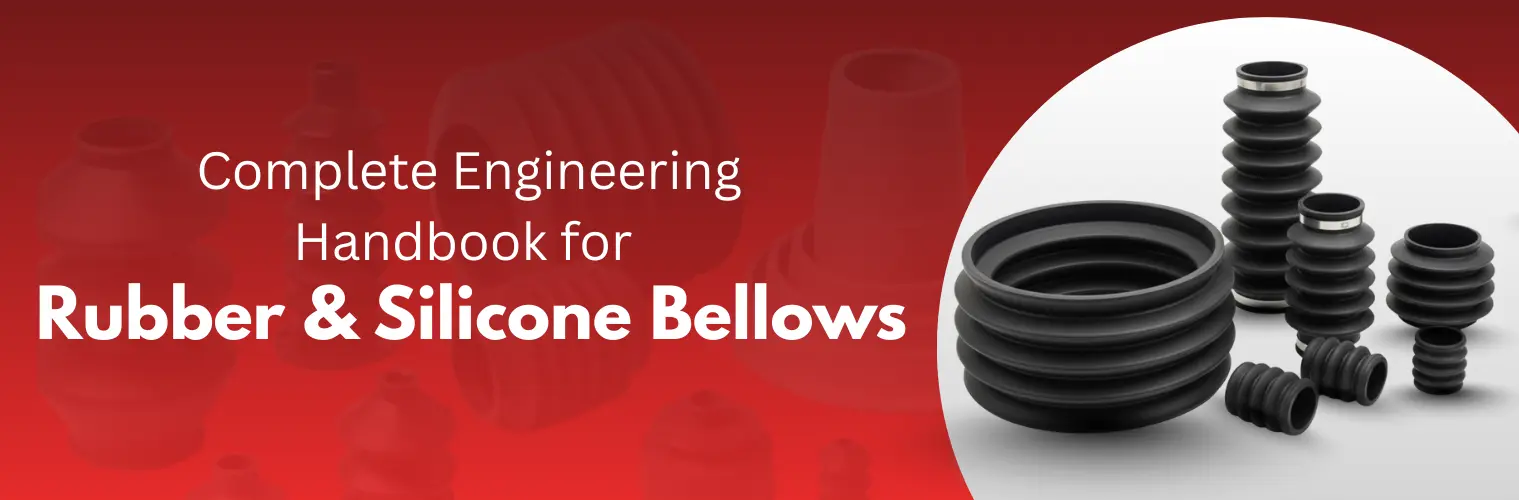
Bellows are flexible components which are used in critical connections. The versatility ranges from simple dust protection to critical pressure containment. The production techniques ensure consistent quality across thousands of identical parts. The engineers must carefully analyse movement patterns before specifying optimal configurations.
What Are Rubber & Silicone Bellows?
Rubber and silicone bellows serve as flexible connectors in countless industrial systems. These convoluted components feature strategic folds to allow movement and maintain a seal.
The bellows absorb vibration or compensate for misalignment. The design enables expansion, compression, and lateral flexing. Most installations require bellows to handle multiple movement types while preventing leakage.
The wall structure varies based on application demands and pressure requirements. Some bellows have reinforced walls to withstand extreme conditions with durability. These are manufactured through molding, extrusion, or hand-building methods.
- Convolution depth specifies extension and compression capabilities
- Durometer (hardness) ratings affect flexibility versus stability characteristics
- Wall thickness variations can create directionally-biased movement properties
- Service life predictions require accounting for cycle frequency and amplitude
- External protective coatings extend performance in harsh environments
Types of Rubber & Silicone Bellows
Bellows has many configurations to meet diverse engineering challenges.
1. By Shape
The cylindrical bellows are used in rotating equipment. Their uniform diameter is the best for shaft protection and flexible connections. The conical variants solve transition problems between different-sized components with gradual tapering. Rectangular designs can cover linear guides and machine ways against contamination.
2. By Function
Axial bellows handle compression and extension along a single axis. The lateral designs absorb side motion and maintain connection integrity between parts. Angular variants compensate for tilting movements in misaligned component connections. The bellows tackle complex multi-directional movement through special convolution geometry.
3. By End Configuration
Flanged bellows allow direct bolt-on mounting for secure, leak-free connections. The beaded ends enable quick snap-fit installation in groove-equipped housings. Cuffed designs work with standard hose clamps for fast field assembly. The molded-in metal inserts reinforce connection points for added strength.
Material Properties: Rubber Compounds
Selecting the right rubber compound determines performance in specific environments.
1. Natural Rubber (NR)
Natural rubber provides elasticity with a temperature range from -50°C to +70°C. The material provides tensile strength and resilience at a moderate cost. The limitations include poor resistance to oils, fuels, and ozone exposure.
2. Neoprene (CR)
Neoprene handles temperatures from -40°C to +100°C with balanced overall properties. Its moderate oil resistance works for occasional exposure situations. Outdoor applications benefit from good weathering characteristics and inherent flame retardance.
3. EPDM
EPDM is the best in extreme weather with temperatures from -50°C to +150°C. It has outstanding ozone and UV resistance. The steam systems and hot water applications perform reliably with this material.
4. Nitrile (NBR)
Nitrile provides good oil resistance within its -30°C to +100°C range. Hydraulic systems specify this material for its fuel compatibility. Its main weakness appears in poor ozone resistance.
5. Viton (FKM)
Viton handles extreme temperatures from -20°C to +200°C with stability. The chemical processing equipment relies on its high resistance to harsh substances. The material withstands fuels, acids, and solvents that destroy other rubbers.
6. Hypalon (CSM)
Hypalon offers good acid resistance between -40°C and +120°C applications. The moderate oil resistance is best for occasional exposure situations. Many chemical environments containing acids often specify this special material.
Material Properties: Silicone Compounds
Silicone materials have a unique molecular structure.
1. Standard Silicone (VMQ)
Standard silicone maintains flexibility from -60°C to +200°C without hardening. Its low-temperature performance exceeds most rubber compounds. The material provides reliable electrical insulation properties.
2. Fluorosilicone (FVMQ)
Fluorosilicone combines fuel resistance with silicone's temperature performance (-55°C to +175°C). The material handles environments containing both extreme temperatures and hydrocarbon exposure.
3. High-Strength Silicone
High-strength silicone has good tear resistance. The special fillers improve abrasion performance and flexibility. The material maintains the same temperature range as standard versions.
4. Liquid Silicone Rubber (LSR)
Liquid silicone enables precision injection molding with tight dimensional tolerances. The complex geometries become possible through its special processing methods. The material produces minimal waste during manufacturing with fast cure cycles.

Why Choose Custom Rubber Bellows?
At Custom Rubber Bellows, we are driven by core values that guide our business and define our commitment to our clients.

Expertise and Experience - With years of experience in the Bellows industries, we have the expertise to deliver custom-designed solutions that meet the most demanding requirements.
High-Quality Products - Our Bellows are made from high-quality materials, ensuring durability, clarity, and long-lasting performance.
Custom Solutions - We specialize in providing tailored Bellows solutions that meet the unique needs of our clients.
Exceptional Customer Service - We provide end-to-end support, from initial consultation to post-delivery assistance, ensuring our clients are delighted with the results.

The engineers should approach the selection methodically through careful system analysis. They must test under actual conditions to provide validation beyond theoretical calculations. Many engineering failures trace back to improper bellows specification or installation. They should avoid these at any cost to provide the best results to the industries.
We have professionals who can take you through the installation and maintenance processes. You can obtain maximum benefits from the following components. To get certain tips on the equipment, call us today 1 917-730-4350 . The info@customrubberbellows.com can also be contacted through email to provide more details on care procedures that will ensure premature failures are avoided.